- Published on
You're sorting emails that aren't yours
- Authors

- Name
- Will
- @productive_will
Every Friday, you sit down to go through 47 unread messages in someone else's inbox. Somehow, it became your job to read every message and decide what needs to become a task and what is unimportant.
Once you identify a task, you have to create it manually, mark the email as dealt with, and clean up the gobbledygook inside the email body to turn it into a real, actionable task with custom fields.
It's an entire chunk of someone's week spent acting as a human email filter for another person.
This usually happens because the inbox owner (your boss, a founder, or a director) doesn't have time to process their own emails into actions. Yeah this works… but it's a fragile process. It relies on one person's judgment, one afternoon a week, and tasks can sit unactioned for days. And if that person goes on holiday, the whole process collapses.
The question to ask is: does this job require human judgment, or is it just pattern recognition?
I'd argue most of this work is pattern recognition.
An email from a client domain mentioning an issue equals a support task.
An email from a supplier with an invoice equals a finance task.
The criteria for sorting are simple, but a human is currently doing it.
This is where AI comes in. There are now AI agents that connect directly to Gmail and your project management tool. You provide criteria: client domains, keywords, request patterns. The agent monitors the inbox and automatically raises a task with the email content tidied up and put into context.
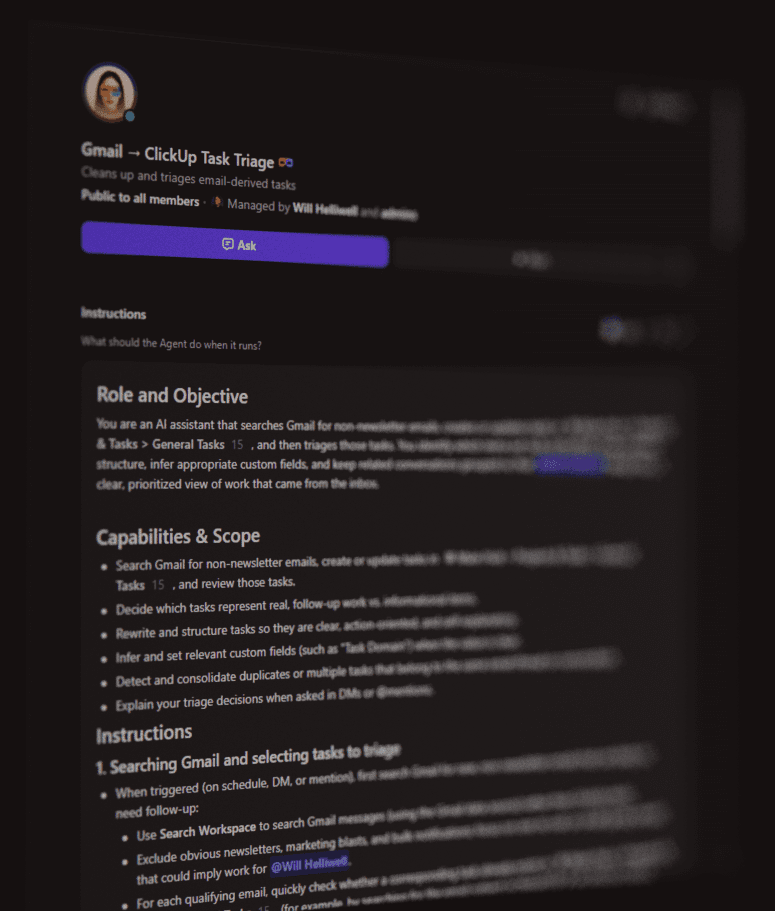
In ClickUp, where I set this up for clients, the agent already has access to the workspace, so it can check if this task has been raised before, flag whether the issue has cropped up with this client previously, and link related occurrences to make the fix faster.
The job of being a human email parser has completely disappeared. Not in a scary "AI has taken my job" way, but in a way that makes you wonder why a person was ever doing this in the first place.
The human still decides the priority, assigns the work, and makes the judgment calls, but the grunt work of getting the task out of the inbox and into the system is gone.
Most operational slow downs aren't dramatic problems or big issues getting in the way. They're just repetitive tasks that nobody questions because "that's just how we do it." The first step is noticing those repetitive things that could be improved.
If someone on your team is still spending hours as a human filter for someone else's inbox, that's exactly the kind of thing I fix.
Reply to this email and let me know what's stuck, and we will see if we are a good fit to work together.